Related MOCs: MOC - Diagnostic & Lab Methods
Upstream: RNA Extraction · Sample Types and Specimen Quality · Nucleic Acid Quantification
Related: PCR · qPCR · Multiplex PCR · Isothermal NAAT · RT-PCR
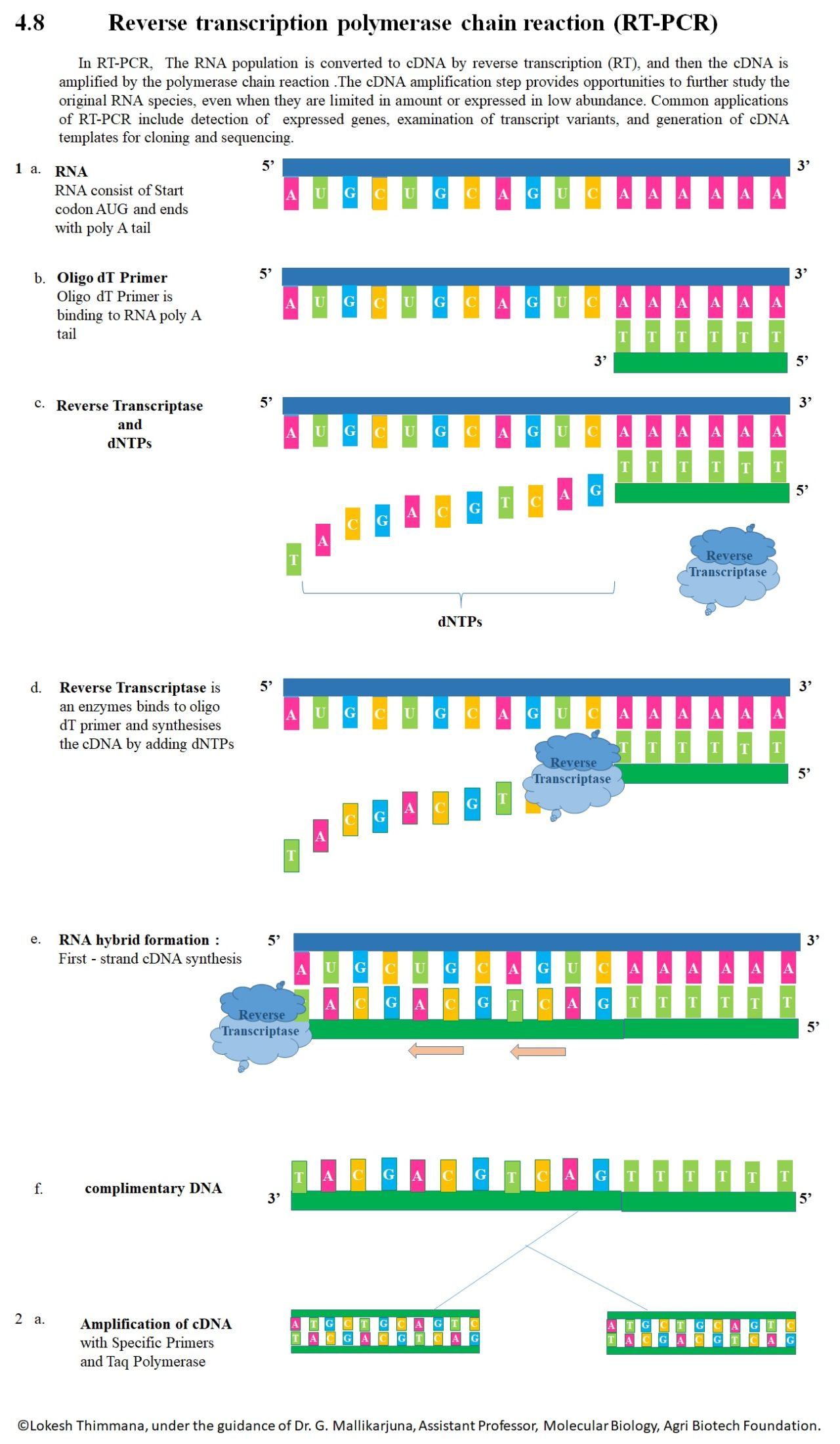
Here is the step-by-step process of reverse transcription polymerase chain reaction (RT-PCR), used to convert RNA into complementary DNA (cDNA) and then amplify it.
•Principle
RT-PCR works in two main steps:
- Reverse Transcription (RT) – RNA is converted into complementary DNA (cDNA).
- Polymerase Chain Reaction (PCR) – The synthesized cDNA is amplified using specific primers and Taq polymerase.
This technique is mainly used to study gene expression and detect RNA viruses.
•Steps Shown in the Picture
1️⃣ RNA Template
• The process begins with mRNA, which has a poly-A tail at the 3′ end.
2️⃣ Oligo-dT Primer Binding
• An oligo-dT primer binds to the poly-A tail of mRNA.
• This primer provides a starting point for DNA synthesis.
3️⃣ Action of Reverse Transcriptase
• The enzyme reverse transcriptase adds dNTPs (A, T, G, C) complementary to the RNA template.
• A cDNA strand is synthesized.
4️⃣ RNA–DNA Hybrid Formation
• A temporary RNA–DNA hybrid molecule is formed.
5️⃣ Formation of Complementary DNA
• The RNA strand is removed.
• A second DNA strand is synthesized, forming double-stranded cDNA.
6️⃣ Amplification by PCR
• The cDNA is amplified using:
• Specific primers
• Taq DNA polymerase
• Multiple copies of the target gene are produced.
•Applications
• Detection of RNA viruses (e.g., COVID-19 testing)
• Gene expression analysis
• Cancer research
• Molecular cloning
• Detection of genetic disorders
•Conclusion
The picture demonstrates how RT-PCR converts RNA into cDNA and amplifies it, allowing scientists to analyze genes that are actively expressed. It is a powerful and sensitive technique widely used in medical diagnostics and research.