Paper Review: Antibiotic Resistance, Tolerance, and Persistence in Tuberculosis and Staphylococcal Infections
Comparative Modeling of Antibiotic Resistance, Tolerance, and Persistence
Vahhab Piranfar · bioRxiv · 2025
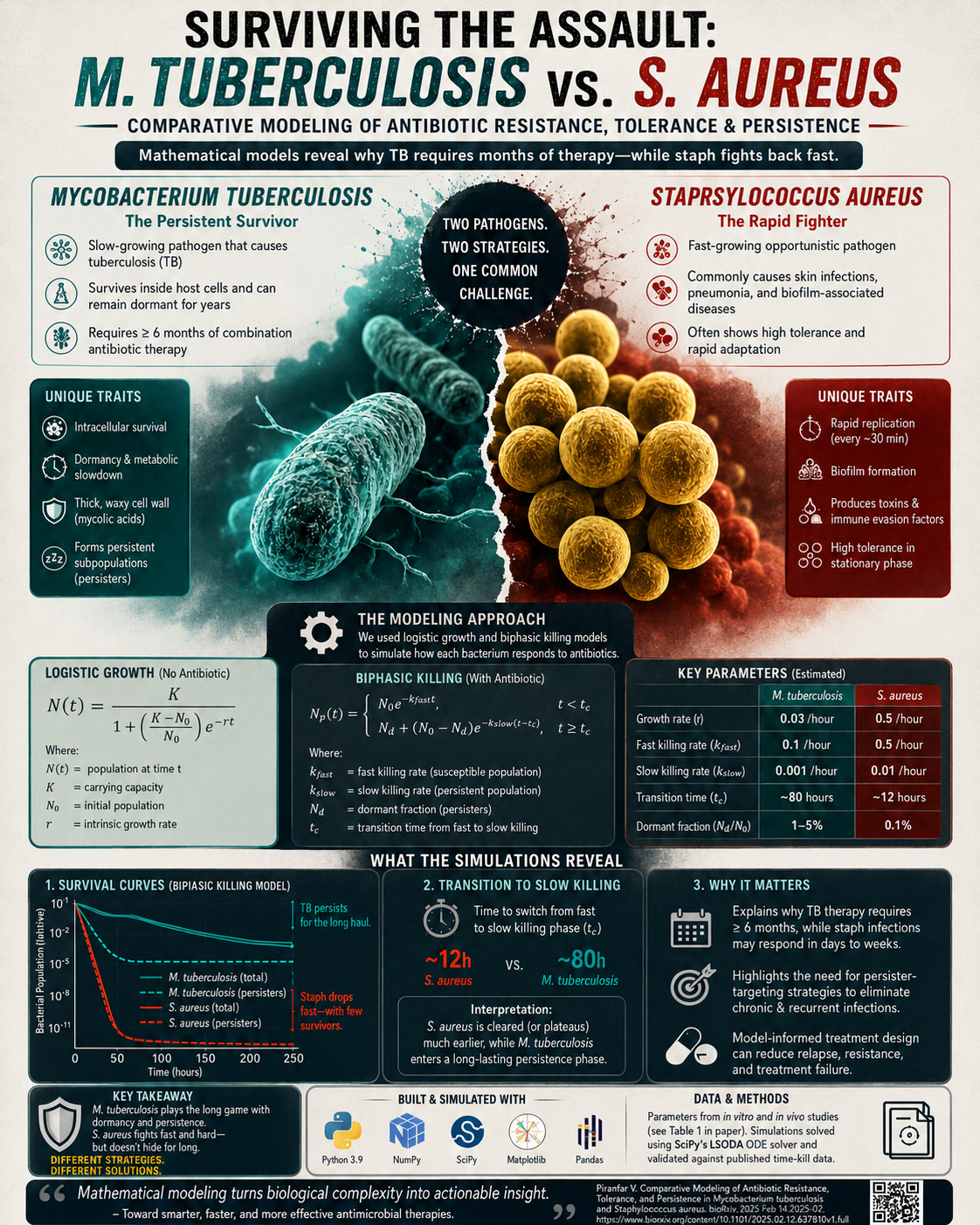
This review looks at the preprint Comparative Modeling of Antibiotic Resistance, Tolerance, and Persistence in Mycobacterium tuberculosis and Staphylococcus aureus, which explores how two very different pathogens respond to antibiotics over time.
This is a preprint, so the findings should be interpreted as an informed modeling study rather than final clinical evidence. Even so, the paper raises important questions about how we define and treat persistence.
Summary
The study compares how M. tuberculosis and S. aureus survive antibiotic exposure using mathematical models and time-kill simulations. The main idea is that the two organisms do not rely on the same survival strategy:
- S. aureus appears to show a more rapid tolerance pattern, with an initial strong decline followed by a slower phase of survival.
- M. tuberculosis appears to maintain a much longer persistence window, consistent with prolonged survival under drug pressure.
This distinction matters because it suggests that treatment failure may not always come from the same mechanism.
Why it matters
The paper is valuable because it forces us to separate three ideas that are often blurred together:
- Resistance: genetic survival despite drug exposure.
- Tolerance: temporary survival of a population under stress.
- Persistence: survival of a small subpopulation that can remain viable over long periods.
For microbiology and infectious disease research, this distinction is critical. A therapy that works for one bacterial survival strategy may fail if the pathogen is using another.
Key interpretation
What I find especially interesting is the contrast between the two pathogens.
For M. tuberculosis, the model suggests a deeper and longer-lasting survival mechanism. That fits the well-known difficulty of tuberculosis treatment: the organism can persist for long periods and may require extended regimens.
For S. aureus, the result suggests that early tolerance may be the dominant issue. In that case, the timing and structure of treatment may be especially important for preventing relapse.
Limitations
As with any modeling paper, the conclusions depend heavily on assumptions.
Some limitations are worth noting:
- The study relies on simplified equations and simulations rather than full experimental heterogeneity.
- Real infections involve host immunity, biofilms, metabolic shifts, and variable drug penetration.
- The model may not fully capture the complexity of patient-specific bacterial behavior.
These are not fatal weaknesses, but they mean the paper should be read as a framework for thinking, not as a final answer.
Final take
The most important message of the paper is that antibiotic survival is not a single phenomenon. Different pathogens may use different strategies, and different strategies may require different treatment approaches.
For me, the strongest takeaway is this:
The challenge is not only killing bacteria quickly, but understanding how they survive long enough to return.